
Assets vs. Inventory: Can You Have Both? (Yes, You Can.)
Blog

Table of Contents
Take Control of Your Assets
A personalized demo is just one click away.
Quick Answer
Assets and inventory are both valuable business resources, but they serve different purposes. Assets are resources an organization uses to operate its business over time, such as equipment, vehicles, computers, or machinery. Inventory consists of goods held for sale or items intended to be consumed during business operations, such as spare parts, medical supplies, or office consumables.
The simplest way to remember the difference is this: assets help you run your business, while inventory helps you deliver products or services. Most organizations manage both and require different processes to track each effectively.
Why People Confuse Assets and Inventory
The terms "asset" and "inventory" are often used interchangeably because both represent things an organization owns, and both appear on the balance sheet. In practice, however, they are managed very differently.
The confusion is especially common in organizations that track a mix of long-term equipment and consumable supplies. An IT department, for example, may manage laptops, servers, keyboards, monitors, and replacement cables. A construction company may track excavators alongside safety equipment and fasteners. A hospital may manage infusion pumps while also monitoring gloves, medications, and surgical supplies.
Although these items may all be managed by the same department—and sometimes even within the same software—they fall into different categories with different tracking requirements. Understanding the distinction helps organizations improve accounting, inventory control, purchasing, maintenance, and operational reporting.
Assets vs. Inventory: Key Differences
| Assets | Inventory |
| Used to support business operations and drive revenue | Sold, consumed, and replenished during operations |
| Typically retained for multiple years | Usually turned over regularly |
| Tracked individually with unique asset IDs | Often tracked in bulk |
| May depreciate over time | Expensed or recognized as cost-of-goods-sold on balance sheet |
| Require lifecycle management | Require inventory-level management and replenishment |
What Is an Asset?
An asset is a resource that provides ongoing value to an organization over multiple accounting periods. Rather than being sold or consumed immediately, assets support day-to-day operations and help employees perform their work.
Examples of business assets include:
- Laptops and servers
- Company vehicles
- Manufacturing equipment
- Construction machinery
- Medical devices
- Office furniture
- Heavy equipment
Because assets remain in service for years, organizations often track detailed lifecycle information, including purchase dates, warranty information, maintenance history, depreciation, inspections, assignments, and eventual retirement. An asset tracking system helps organizations maintain visibility into each asset throughout its lifecycle while improving accountability and reducing loss.
What Is Inventory?
Inventory consists of items that are sold to customers or consumed as part of normal business operations. For retailers and manufacturers, inventory typically refers to products held for sale. For many other organizations, inventory includes supplies and consumables that support daily operations.
Examples include:
- Retail merchandise
- Raw materials
- Spare parts
- Medical supplies
- Office supplies
- Cables, keyboards, and computer peripherals
Unlike assets, inventory is generally managed by quantity rather than as individual items. Organizations focus on stock levels, reorder points, demand forecasting, and replenishment to ensure inventory is available when needed without carrying unnecessary excess.
Asset Tracking vs. Inventory Management
Although the two disciplines are related, they solve different operational challenges.
Asset Tracking Focuses on Lifecycle Management
Asset tracking helps organizations monitor individual assets from acquisition through disposal.
Typical asset management activities include:
- Assigning assets to employees or locations
- Tracking maintenance and repairs
- Monitoring depreciation
- Scheduling inspections
- Managing warranties and service contracts
- Recording transfers and disposals
The objective is to maximize asset value while maintaining accountability throughout its lifecycle.
Inventory Management Focuses on Stock Availability
Inventory management helps organizations maintain the right quantity of items at the right time.
Common inventory management activities include:
- Tracking quantities on hand
- Monitoring stock movement
- Setting reorder points
- Forecasting demand
- Managing replenishment
- Conducting inventory counts
Rather than tracking the history of individual items, inventory management focuses on maintaining appropriate stock levels and ensuring products or supplies are available when needed.
4 Examples of Organizations that Need Both Asset and Inventory Management
Construction
Construction companies often track equipment such as generators, compressors, and excavators as assets while managing fasteners, adhesives, PPE, and replacement parts as inventory.
Healthcare
Hospitals manage medical devices like infusion pumps and imaging equipment as assets while tracking medications, gloves, syringes, and surgical supplies as inventory.
Information Technology
IT departments typically manage laptops, servers, network infrastructure equipment, and mobile devices as serialized assets while tracking keyboards, cables, monitors, adapters, and other peripherals as inventory or consumables.
Government and Public Sector
Government agencies may track fleet vehicles, emergency equipment, and facilities assets individually while maintaining inventories of emergency supplies, office materials, and operational equipment.
Although these resources require different tracking methods, many organizations benefit from managing both within a single configurable platform.
Can One System Track Both Assets and Inventory?
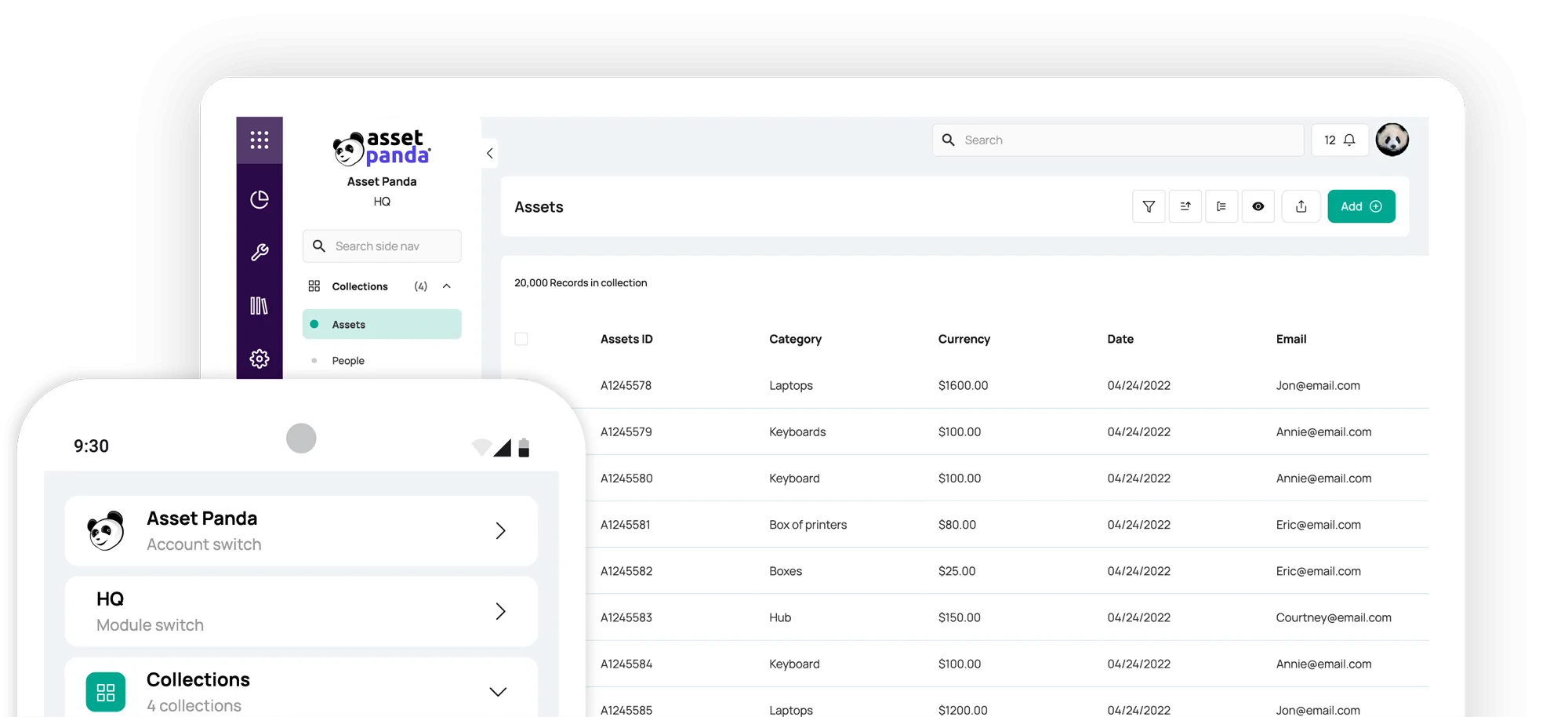
A comprehensive system like Asset Panda Pro enables you to track unique assets and consumables in one centralized place. No matter which solution you're considering, it's important that your chosen system can be customized to fit your assets and your inventory as well as the workflows they're associated with.
A serialized asset, such as a laptop or company vehicle, typically requires its own record with assignment history, maintenance logs, warranty information, and depreciation.
Inventory, on the other hand, is often managed as a quantity. Rather than creating individual records for every keyboard, box of gloves, or package of fasteners, organizations usually track quantities, locations, and reorder thresholds.
A flexible platform allows organizations to configure each category differently while maintaining one centralized system of record. This approach eliminates duplicate systems, improves reporting, and gives departments visibility into both long-term assets and operational inventory.
How Asset Panda Helps Manage Assets and Inventory
Understanding the difference between assets and inventory is more than an accounting exercise; it influences how organizations purchase, track, maintain, and report on the resources that keep their operations running.
Assets provide long-term operational value and require lifecycle management. Inventory is sold or consumed during normal operations and requires careful monitoring of stock levels and replenishment. Most organizations manage both.
By using a system that supports serialized assets alongside quantity-based inventory, teams can improve visibility, simplify reporting, and reduce the complexity of managing multiple tracking systems. If you're in search of the right system for your organization, look no further than Asset Panda.
Asset Panda provides organizations with a configurable platform for tracking both fixed assets and inventory from a single system.
With Asset Panda, organizations can:
- Track the full lifecycle of assets and their depreciation
- Monitor inventory quantities and locations
- Configure different workflows for different asset categories
- Generate audit and inventory reports
- Improve accountability across departments
- Access inventory and asset data from mobile devices
Because Asset Panda is highly configurable, organizations don't have to choose between an asset tracking system and an inventory management system—they can manage both in one centralized, easy-to-use platform.
Ready to see how Asset Panda can streamline your asset and inventory tracking? Schedule your personalized demo now.
Take Control of Your Assets
A personalized demo is just one click away.
Frequently asked questions
What is the difference between assets vs inventory?
Assets are long-term resources used to operate a business, such as vehicles, equipment, computers, and machinery. Inventory consists of goods that are sold to customers or consumed during business operations, including products, supplies, spare parts, and consumables.
Is inventory considered an asset?
Yes. From an accounting perspective, inventory is classified as a current asset because it has economic value and is expected to be sold or used within a relatively short period. Operationally, however, inventory is managed differently from fixed assets because it focuses on quantities, stock levels, and replenishment rather than lifecycle management.
Can one system manage both assets and inventory?
Yes. Many modern platforms allow organizations to manage serialized assets and quantity-based inventory within the same system while using different workflows, fields, and reporting for each resource type.
Which industries need both asset tracking and inventory management?
Organizations across construction, healthcare, manufacturing, IT, education, government, utilities, and facilities management often need both. They typically manage long-term operational assets alongside consumable inventory, supplies, or products that require replenishment.
Related Resources



Learn more from a solution specialist
Schedule a demo to find out how you can transform your workflows with Asset Panda Pro
Contact our team at (888) 928-6112