
Centralized Control, Distributed Assets: How to Track Inventory Across Locations
Blog

Table of Contents
Take Control of Your Assets
A personalized demo is just one click away.
The operations leaders we speak with rarely describe their inventory problem as a tracking problem; they describe it as a decision problem. When a procurement director cannot answer how many laptops sit unused across 40 clinics, or a program manager cannot tell auditors which client received which device, the gap is not a lack of visibility into a single asset. The gap is the absence of a single source of truth across every location, every program, and every person.
This piece is for operations, IT, and program leaders weighing whether their current setup can carry the next phase of growth. The argument is straightforward: distributed assets need centralized control, and the strategic value of a unified inventory system shows up in faster decisions, tighter cost discipline, and audit readiness that siloed spreadsheets and half-built tools cannot match.
Key Summary
- Decentralized inventory across dozens or hundreds of locations creates compounding blind spots that no amount of local diligence can close.
- A unified database must deliver both location-specific views and rolled-up totals in the same query, not as separate reports stitched together later.
- User-based assignment (who has what) is a distinct requirement from location assignment (where fixed assets live), and conflating the two leaves accountability gaps.
- Service organizations dispensing assets to individual clients need a tracking model that goes beyond org-level or clinic-level aggregates.
- Choosing inventory infrastructure is a scaling decision, not a feature decision. The wrong platform forces a rebuild; the right one absorbs volume growth.
The Hidden Cost of Distributed Inventory Without Central Control
When inventory lives in separate spreadsheets, shared drives, or location-specific tools, the cost is not just inefficiency. It is sunk investment, stalled audits, and decisions made on stale data. One nonprofit healthcare operation we heard from in customer interviews had already spent into the hundreds of thousands of dollars trying to stand up an in-house inventory system before the project was abandoned mid-build, leaving the organization with neither the working system nor the budget to start fresh.
That pattern is more common than the headline number suggests. Organizations commission a custom build or stitch together adjacent tools for multi-location tracking, scope expands as new asset categories surface, and the project either ships incomplete or never ships at all. By the time leadership pulls the plug, the budget is gone, and the original problem has gotten worse.
What the sunk-cost trap actually costs
The direct spend is the smaller half of the loss. The larger half is the months or years during which procurement runs blind, finance writes off untracked equipment, and IT cannot confirm whether a laptop assigned to a remote employee was ever returned. The half-built system becomes operationally paralyzed: too expensive to abandon but too fragmented to properly use.
Why local diligence does not scale
Individual site managers can be meticulous. A clinic lead can keep a clean spreadsheet for her location. The problem is that 40 clean spreadsheets do not aggregate into one trustworthy view. Differences in field names, asset categories, and update cadence mean every rollup is a reconciliation project, and reconciliation projects do not survive turnover.
The Scale Problem: When Locations and Headcount Outgrow Spreadsheets
Decentralized approaches collapse predictably at a specific threshold: when an organization crosses roughly 1,000 employees and spreads across dozens of physical sites. One nonprofit healthcare organization we heard from in interviews operates with approximately 2,000 employees across roughly 150 locations, and at that scale, location-by-location inventory reconciliation stops being inefficient and starts being impossible.
The scale story is not just about counting more rows. It is about parallel growth in three dimensions at once: more locations, more asset categories, and more types of assignment relationships.
More locations mean more reconciliation surface
Each new site adds not one spreadsheet but a web of edge cases. A satellite clinic that occasionally borrows equipment from the main campus. A pop-up community event that pulls inventory from three different stockrooms. A new program location that needs both IT devices and program-specific supplies on day one. None of these is solvable at the location level. They require a system that already knows about every other location.
More asset categories mean more schemas
A mature operation rarely tracks only laptops. The same nonprofit weighing centralization may simultaneously be governing IT devices, fixed equipment bound to a building, mobile assets checked out to staff, community and event assets, clinic or program equipment, and even food bank inventory feeding direct service delivery. Each category has its own attributes and lifecycle, and building a separate database for each one rebuilds the original silo problem.
More assignment types mean more accountability gaps
At a small scale, knowing an asset is at a location is enough. At 150 locations, leaders need to know which employee holds it, which client received it, and when it last moved. Spreadsheets can record one of those relationships well. They cannot maintain all three concurrently across thousands of assets.
What a Unified Inventory Database Actually Enables
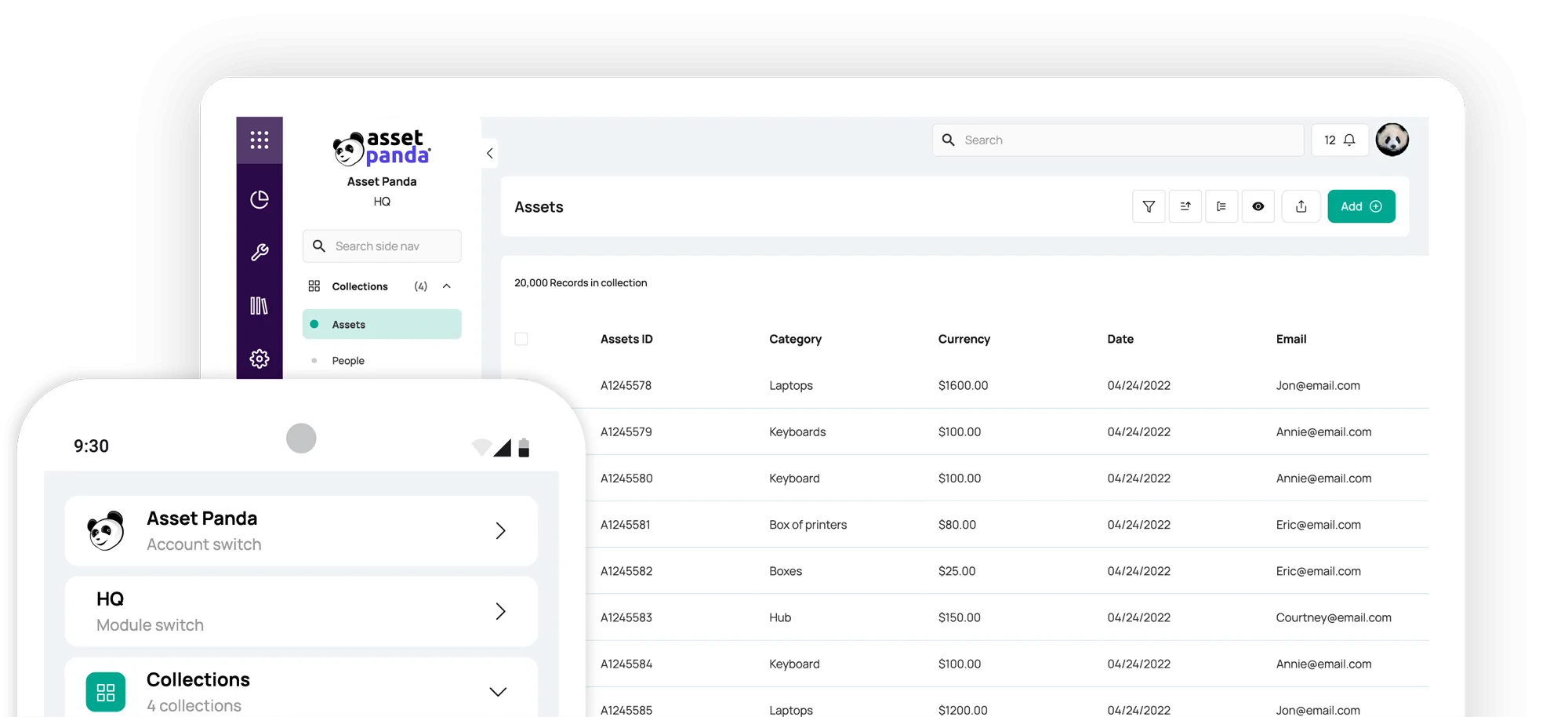
A unified inventory database is one system that holds every asset record across every location and surfaces both location-specific detail and rolled-up totals across all sites in the same view. The strategic payoff is decision speed: procurement, finance, and operations leaders stop waiting for reconciliation reports and start querying live data directly.
In customer interviews, the requirement was articulated cleanly: leaders need to see the inventory at any single location, and they need to see the total across all locations, without those being two different reports built from two different data pulls. That dual-view requirement is the operational definition of "centralized" in this context.
Faster procurement and capital decisions
When a CFO can pull a real-time count of underutilized laptops across all sites, the next purchase order shrinks. When a facilities director can see which locations are over-equipped on a given asset class, redistribution replaces buying. The rolled-up view turns idle inventory into a budget line item leadership can actually act on.
Audit readiness as a byproduct
Nonprofit healthcare operations carry compliance and stewardship obligations that for-profit peers often do not. Donors, grantors, and regulators expect documented chain of custody. A single database with location and user assignment history produces audit-ready reports without a quarterly scramble, because the documentation is the same data leadership uses every day.
Procurement efficiency across categories
When the same platform governs IT, equipment, event assets, and program inventory, procurement teams stop juggling vendor portals and category-specific trackers. One requisition workflow, one approval chain, one source of truth on what is already in stock somewhere in the network.
User-Based Assignment: Knowing Who Has What, Not Just Where It Is
User-based assignment records show which specific employee holds an asset, which is treated as a distinct data relationship from where a fixed asset is physically located. Both relationships matter, and a centralized inventory system has to maintain them in parallel rather than forcing one to substitute for the other.
Customer interviews surfaced this pattern repeatedly: organizations could answer "where is this projector" but not "which staff member is responsible for this laptop right now," or vice versa. The two questions look similar and require different data structures.
Fixed assets versus mobile assets
A wall-mounted display in a clinic exam room is a fixed asset. Its primary relationship is to a location. A laptop issued to a case manager who works across three sites is a mobile asset. Its primary relationship is to a person. Treating them with the same data model produces either lost mobile assets or pointless location updates for items that never move. A platform that supports user-level assignment and location-level assignment as parallel concepts handles both cleanly.
Why person-level accountability matters
When a remote employee leaves the organization, the offboarding workflow has to know exactly which devices were in their possession. When a piece of clinical equipment is damaged, leadership needs to know who last had it. Integrations with directory systems, such as Asset Panda's Microsoft Active Directory on-premises integration for synchronizing employee directories, make person-level assignment maintainable as headcount changes, which it constantly does in growing organizations.
Managing Diverse Asset Types Under One Roof
A centralized asset inventory system has to govern every asset category the organization actually manages, not just the easy ones. In customer interviews, the in-scope categories regularly included IT devices, fixed equipment, mobile assets assigned to staff, community and event assets, clinic or program equipment, and program-specific inventory such as food bank stock.
Spinning up a separate database for each category recreates the original silo problem in a more sophisticated form. The strategic move is the opposite: define the full scope of asset categories up front, then select a platform that can model all of them in one database.
Scoping the inventory before selecting a platform
Before evaluating any system, leadership should answer a concrete question: which asset types will this platform govern? The answer is rarely just IT. Once equipment, vehicles, event assets, and program supplies enter the scope, the platform requirements shift. Multi-category scoping is a strategic exercise, not a procurement formality.
Asset categories to map before you choose:
- IT devices, including laptops and remote-managed endpoints
- Fixed equipment bound to specific locations
- Mobile assets checked out to individual staff
- Community and event assets that move between sites
- Clinic or program-specific equipment
- Program inventory, such as food bank stock or client-dispensed supplies
Avoiding the multi-database trap
When each asset category lives in its own system, every cross-category question (how much equipment does this program use in total, including IT and supplies) becomes a manual stitching exercise. A single platform with configurable record types per category preserves category-specific detail without sacrificing rolled-up reporting.
Is Your Current System Built for This? An Evaluative Checklist
If your team is weighing whether to extend the current setup or replace it, run through these questions before the next budget cycle.
- Can a single query return both a location-specific inventory and a rolled-up total across all locations, without exporting and merging spreadsheets?
- Can the system show which specific employee holds a given mobile asset, and which location a given fixed asset is bound to, as two distinct relationships?
- If your programs dispense assets to individual clients, can the system record the client-level dispensing event in a way that supports audit and follow-up?
- Does the same database govern IT, equipment, event assets, and program-specific inventory, or are you maintaining parallel systems per category?
- If you doubled locations or headcount in the next 24 months, would the current system absorb the growth, or would you need to rebuild?
If two or more of those answers are uncomfortable, the current setup is unlikely to carry the next phase of growth.
Streamline Multi-Location Asset Inventory Management with Asset Panda
Centralized inventory management is a leadership lever, not a tracking exercise. The organizations that get it right treat the platform decision as infrastructure for the next decade of growth, scope every asset category and assignment relationship before evaluating tools, and refuse to accept rolled-up reports that require reconciliation to trust.
If you are weighing whether your current setup can carry that load, the practical next step is a side-by-side look at how a purpose-built platform handles multi-location, multi-category, and user- and client-level assignment in one database. Compare your current configuration against a centralized model with an Asset Panda specialist, or request a personalized demo to see the rolled-up view in action against your real asset mix.
Take Control of Your Assets
A personalized demo is just one click away.
Related News & Press



Frequently asked questions
At what scale does decentralized inventory management actually break down?
The pattern we see in customer interviews puts the breaking point somewhere between 1,000 and 2,000 employees and several dozen locations. One nonprofit healthcare organization referenced in interviews was operating at approximately 2,000 employees across roughly 150 locations, and at that scale, location-by-location reconciliation had stopped producing reliable rollups. The exact threshold depends on asset category diversity, but multi-site organizations rarely outrun decentralized tools beyond that range.
Why is user-based assignment treated as separate from location assignment?
They answer different questions. Location assignment tells you where a fixed asset physically lives. User-based assignment tells you which person is currently responsible for a mobile asset. A laptop assigned to a remote employee who works across three clinics has a meaningful user relationship and a less meaningful location relationship. A wall-mounted monitor in an exam room is the opposite. A system that supports both relationships in parallel handles real-world inventory; a system that only supports one forces awkward workarounds.
What asset categories should we scope before evaluating a centralized platform?
At minimum, scope IT devices, fixed equipment, mobile assets assigned to staff, community or event assets, clinic or program-specific equipment, and any program inventory such as food bank stock or client-dispensed supplies. The point of scoping up front is to avoid choosing a platform that handles two of those categories well and forces you back into a separate system for the others.
How do we avoid repeating the half-built system mistake?
The organizations that wrote off significant investment on abandoned builds typically started by solving a narrow asset-tracking problem and discovered the scope was much larger than the original architecture could handle. The defensive move is to scope every asset category, every assignment relationship, and every reporting view up front, then evaluate platforms against that full scope rather than against the easiest subset of it.
Learn more from a solution specialist
Schedule a demo to find out how you can transform your workflows with Asset Panda Pro
Contact our team at (888) 928-6112