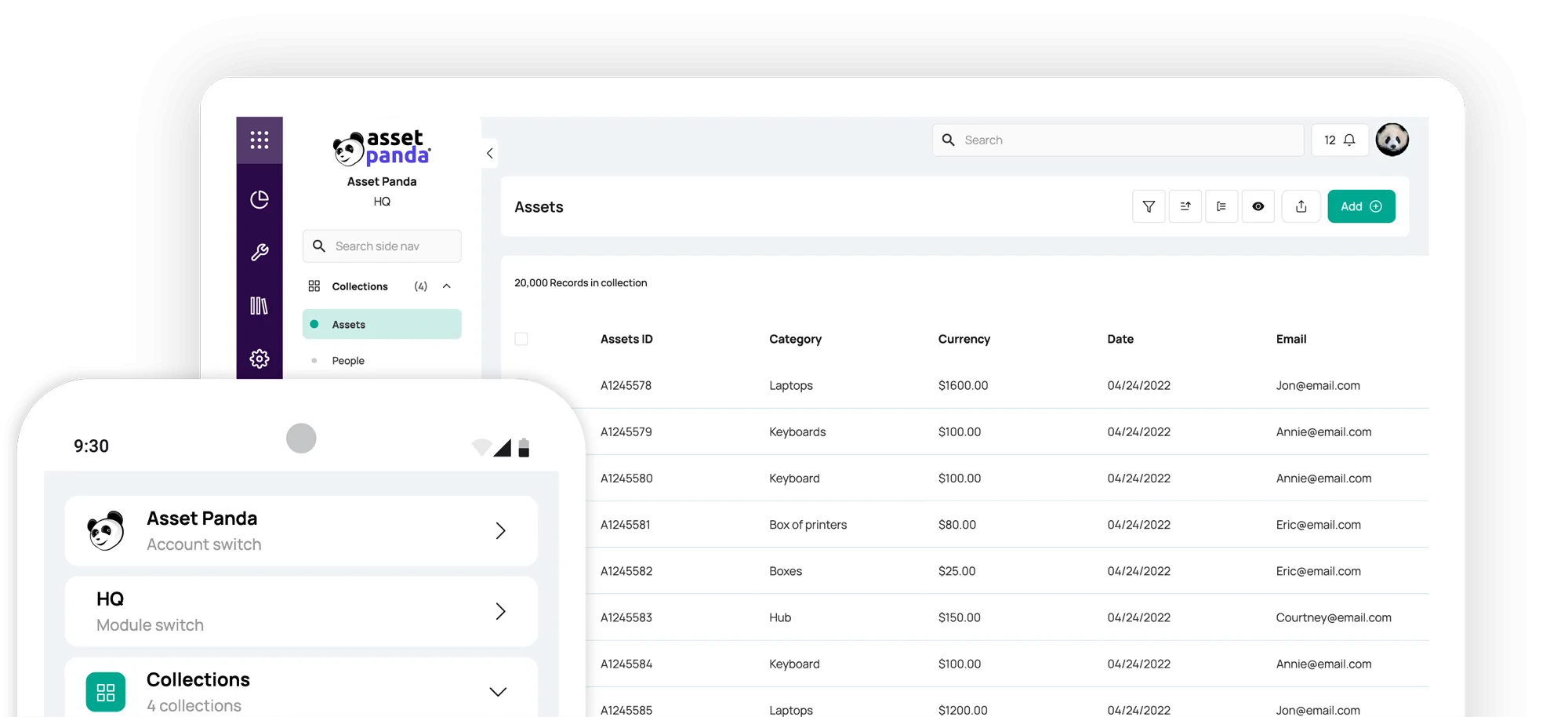
The Best Asset Management Software of 2026
Compare Asset Panda

Asset management success is no longer about tracking items; it’s about who can participate, how fast work happens, and whether systems scale without friction. Legacy tools lock access behind per-user pricing and silo assets by department. Modern platforms unify IT, facilities, maintenance, and finance in one system, without penalizing growth.
Below are the best asset management software platforms, ranked for flexibility, scalability, and real-world usability.
Quick Summary
- Top asset management software in 2026 enables full asset lifecycle tracking, maintenance automation, and seamless enterprise integrations.
- Asset Panda ranks #1 for its asset-based pricing, unlimited users, and unified management of IT, facilities, maintenance, and fixed assets, making it a highly scalable choice for modern organizations.




Rated highly across enterprise, education, healthcare, and operations teams
Free Version: Yes (7-day trial)
Pricing model: Asset-based (unlimited users)
Platforms supported: Web, iOS, Android (offline mode supported)


Why Use Asset Panda?
Asset Panda is the only platform on this list built around an asset-based pricing model, allowing unlimited users to access, scan, audit, and update assets without per-seat costs. This approach removes the typical growth penalty of user-based pricing and enables full organizational participation, resulting in more accurate data and faster asset workflows.
Unlike point solutions, Asset Panda unifies IT Asset Management (ITAM), maintenance management (CMMS), and fixed asset tracking with depreciation in a single configurable platform. Teams can manage laptops, facilities equipment, vehicles, tools, and financial assets using the same mobile apps, workflows, and reporting tools.
Native integrations with Slack, Microsoft Teams, Zendesk, and ServiceNow, along with built-in automations, audits, reservations, and depreciation tracking, make Asset Panda a true system of record rather than a departmental tool.
Key Features
- Unified tracking for IT, facilities, fleet, equipment, and fixed assets
- Highly configurable data model (collections, categories, attributes)
- Barcode and QR code scanning via mobile apps
- Offline mobile mode for audits and inspections
- Built-in automations, alerts, and lifecycle workflows
- Asset depreciation with multiple supported methods
- Dashboards, saved views, and scheduled reporting
- Open API and native integrations
See Asset Panda in Action
Experience a unified asset management platform built for scale.

SafetyCulture
Best for: Inspection- and checklist-driven teams
Free Version: Yes (up to 10 users)
Pricing: $24/user/month
Platforms: Web, iOS, Android
Overview
SafetyCulture is widely used for inspections, audits, and operational checklists. It supports asset-related workflows through templates and inspections, helping teams monitor asset condition, maintenance, and compliance.
Features
- QR and barcode scanning
- Geo-tagging for off-site assets
- Scheduled inspections and maintenance
- Issue reporting and action tracking
- Real-time dashboards and analytics
- Media attachments and cloud reporting
Limitation: Focuses on inspections rather than full asset lifecycle management and does not provide built-in depreciation or advanced asset hierarchy features.

AVEVA Enterprise Asset Management
Best for: Midsize to large industrial organizations
Free Version: Not available
Pricing: Available upon request
Platforms: Web
Overview
AVEVA EAM focuses on reliability, work management, and asset investment visibility for asset-intensive environments.
Features
- Preventive maintenance
- MRO inventory management
- Work scheduling and approvals
- Reliability and condition analysis
- Analytics and reporting
Limitation: Designed primarily for industrial maintenance environments and may be overly complex for organizations seeking simpler asset tracking solutions.
ManagerPlus (Eptura Asset)
Best for: Maintenance-driven organizations
Free Version: Not available
Pricing: Starts at $85/month
Platforms: Web, iOS, Android
Overview
ManagerPlus centers on equipment maintenance, work orders, and service history.
Features
- Preventive maintenance
- Work order management
- Inventory management
- Fixed asset tracking
- Alerts and notifications
Limitation: Primarily focused on maintenance operations rather than broader enterprise asset management across multiple departments.
InvGate Assets
Best for: IT asset lifecycle management
Free Version: Not available
Pricing: Available upon request
Platforms: Web, iOS, Android, Windows
Overview
InvGate focuses on IT hardware, software, and license management with service desk alignment.
Features
- IT asset inventory
- Software license management
- Asset lifecycle tracking
- Dashboards and analytics
- Ticketing integrations
Limitation: Built primarily for IT asset management and does not support operational asset types like facilities equipment or maintenance workflows.

Sage Fixed Assets
Best for: Accounting and tax compliance
Free Version: Not available
Pricing: Available upon request
Platforms: Windows, Web
Overview
Sage Fixed Assets is designed primarily for depreciation accuracy and financial reporting.
Features
- Depreciation calculation engine
- Fixed asset accounting
- Asset tracking and reporting
- Compliance support
Limitation: Focuses on financial asset accounting rather than operational asset tracking, maintenance management, or mobile asset updates.

SAP Asset Manager
Best for: SAP-centric enterprises
Free Version: Not available
Pricing: Starts at $178/user/month
Platforms: Web, iOS, Android, Windows
Overview
SAP Asset Manager supports large-scale asset lifecycle and maintenance operations within the SAP ecosystem.
Features
- Maintenance planning and execution
- Asset health monitoring
- Predictive analytics
- Work order management
- Geospatial enablement
Limitation: Most effective for organizations already running SAP and often requires significant implementation effort and system configuration.
IBM Maximo
Best for: Large, asset-intensive enterprises
Free Version: Not available
Pricing: Available upon request
Platforms: Web, iOS, Android, Windows
Overview
IBM Maximo is a comprehensive EAM platform leveraging AI and IoT for predictive maintenance.
Features
- Asset and maintenance management
- Predictive maintenance
- Inventory and work order tracking
- Remote monitoring
- Barcoding and RFID
Limitation: Implementation and ongoing administration can be complex and resource-intensive compared to lighter asset management platforms.

AssetExplorer (ManageEngine)
Best for: IT asset inventory
Free Version: Yes
Pricing: ~$955 for 250 IT assets (one-time)
Platforms: Web, Android
Overview
AssetExplorer focuses on IT hardware and software asset tracking with license compliance.
Features
- IT asset inventory
- Software license management
- Purchase order tracking
- CMDB functionality
- Reporting and analytics
Limitation: Focused primarily on IT assets and lacks broader operational asset tracking and maintenance capabilities.

Freshservice
Best for: IT service desks
Free Version: Not available
Pricing: Starts at $19/user/month
Platforms: Web, iOS, Android
Overview
Freshservice combines ITSM and asset tracking in a help desk–centric platform.
Features
- Asset lifecycle management
- Automated discovery
- Contract and vendor management
- Reporting and dashboards
Limitation: Asset management features are primarily designed for IT environments rather than enterprise-wide asset tracking.

AssetWorks
Best for: Public sector and higher education
Free Version: Not available
Pricing: Available upon request
Platforms: Web
Overview
AssetWorks specializes in capital asset accounting, fleet, and property management.
Features
- Fixed asset accounting
- Depreciation management
- Work order management
- Inventory tracking
Limitation: Primarily focused on capital asset accounting and public-sector workflows rather than flexible cross-department asset management.
UpKeep
Best for: Facilities and maintenance teams
Free Version: Limited
Pricing: Subscription-based
Platforms: Web, iOS, Android
Overview
UpKeep emphasizes preventive maintenance and facility operations.
Features
- Work order management
- Preventive maintenance
- Asset tracking
- Mobile-first workflows
Limitation: Primarily focused on maintenance management rather than comprehensive asset lifecycle tracking across multiple departments.

MaintainX
Best for: Maintenance teams and frontline operations
Free Version: Yes (limited)
Pricing: Starts around $16/user/month
Platforms: Web, iOS, Android
Overview
MaintainX is a mobile-first maintenance and operations platform used by manufacturing, facilities, and field service teams to manage work orders, inspections, and asset maintenance. Its strength lies in usability and rapid frontline adoption.
Features
- Work order and maintenance management
- Preventive maintenance scheduling
- Asset tracking and service history
- Mobile inspections and checklists
- Parts inventory management
- Team messaging and collaboration
Limitation: Focused on maintenance workflows rather than cross-department asset management.

Limble CMMS
Best for: Mid-sized maintenance and reliability teams
Free Version: Limited Trial
Pricing: Starts around $28/user/month
Platforms: Web, iOS, Android
Overview
Limble CMMS is designed to simplify preventive maintenance and equipment reliability for facilities and manufacturing teams. It combines asset records, work orders, and maintenance analytics in a modern interface.
Features
- Preventive maintenance scheduling
- Work order automation
- Asset health tracking
- Maintenance analytics and reporting
- Spare parts inventory
- Mobile maintenance management
Limitation: Focused on maintenance workflows rather than cross-department asset management.
Snipe-IT
Best for: Budget-conscious IT teams
Free Version: Yes (self-hosted)
Pricing: Subscription for hosted version
Platforms: Web
Overview
Snipe-IT is an open-source IT asset tracking tool.
Features
- IT asset inventory
- License tracking
- Basic reporting
- User assignment tracking
Limitation: Focused on IT inventory tracking and lacks advanced automation, maintenance management, and cross-department asset capabilities.
HxGN EAM
Best for: Heavy manufacturing and utilities
Free Version: Not available
Pricing: Available upon request
Platforms: Web
Overview
HxGN EAM is designed for complex industrial asset environments.
Features
- Asset performance management
- Maintenance planning
- Reliability analysis
- Enterprise reporting
Limitation: Designed primarily for large asset-intensive industries and may require significant configuration for smaller organizations.

Accruent
Best for: Large-scale facilities and real estate portfolios
Free Version: Not available
Pricing: Available upon request
Platforms: Web
Overview
Accruent offers a suite of tools for facilities, real estate, and maintenance management.
Features
- Facilities and space management
- Maintenance workflows
- Capital planning
- Reporting and analytics
Limitation: Focuses primarily on facilities and real estate management rather than broader enterprise asset tracking across IT, equipment, and operational assets.
Top Asset Management Software Comparison Table
| Software | Pricing Model | Primary Focus | Mobile App | Offline Mode |
|---|---|---|---|---|
| Asset Panda | Asset-based (Unlimited Users) | IT, Facilities, Maintenance, Fixed Assets | ✔️ | ✔️ |
| SafetyCulture | $24/user/month | Inspections & Checklists | ✔️ | Limited |
| AVEVA EAM | Request pricing | Industrial EAM | ❌ | ❌ |
| ManagerPlus (Eptura Asset) | $85+/month | Equipment Maintenance | ✔️ | Limited |
| InvGate Assets | Request pricing | IT Asset Lifecycle | ✔️ | Limited |
| Sage Fixed Assets | Request pricing | Depreciation & Accounting | ❌ | ❌ |
| SAP Asset Manager | $178/user/month | Enterprise Asset Management | ✔️ | Limited |
| IBM Maximo | Request pricing | Enterprise / Industrial EAM | ✔️ | Limited |
| AssetExplorer | $955 / 250 IT assets | IT Asset Inventory | ✔️(Android) | ❌ |
| Freshservice | $19/user/month | ITSM + Assets | ✔️ | Limited |
| AssetWorks | Request pricing | Public Sector Asset Accounting | ❌ | ❌ |
| UpKeep | Subscription-based | Facilities & CMMS | ✔️ | Limited |
| MaintainX | $16+/user/month | Maintenance & Operations | ✔️ | Limited |
| Limble CMMS | $28+/user/month | Preventive Maintenance | ✔️ | Limited |
| Snipe-IT | Subscription (Hosted) | IT Inventory | ❌ | ❌ |
| HxGN EAM | Request pricing | Heavy Manufacturing | ❌ | ❌ |
| Accruent | Request pricing | Facilities & Real Estate | ❌ | ❌ |
| Eptura Asset | Request pricing | Equipment-Centric Maintenance | ✔️ | Limited |
Need help choosing the right asset management platform?
Our experts can guide you to the best fit for your needs.
What Is Asset Management Software?
Asset management software is a centralized platform that tracks assets throughout their lifecycle, providing real-time visibility into location, condition, ownership, and usage.
Key Features to Look for in Asset Management Software
Don’t buy asset management software without validating these capabilities:
Asset lifecycle management
A modern asset management platform should track assets from acquisition and deployment through maintenance, reassignment, depreciation, and retirement. Full lifecycle visibility ensures teams understand total cost of ownership, asset age, condition, and replacement timelines.
Preventive and reactive maintenance
Look for software that supports both scheduled preventive maintenance and reactive work orders. Automated maintenance schedules, inspection intervals, and escalation workflows help reduce downtime while ensuring urgent issues are addressed quickly.
Mobile and offline access
Field teams need the ability to scan, update, and audit assets from mobile devices. Offline functionality is critical for warehouses, job sites, and remote locations where connectivity is unreliable.
Asset tracking with barcodes, QR codes, or RFID
Efficient asset tracking requires support for multiple identification methods, including barcodes, QR codes, and RFID. Scanning should instantly surface asset records, enabling fast check-in/check-out, audits, and updates.
Alerts and notifications
Real-time alerts keep teams informed about overdue maintenance, expiring warranties, compliance issues, and asset status changes. Configurable notifications ensure the right people are notified at the right time.
Automation and workflow management
Automation reduces manual effort by triggering actions based on asset events or schedules. Examples include auto-assigning maintenance tasks, notifying stakeholders of status changes, or updating records based on predefined rules.
Reporting and analytics
Strong reporting tools turn asset data into actionable insights. Look for customizable reports, dashboards, and filters that support operational tracking, compliance reviews, and executive decision-making.
Software integrations
Asset management software should integrate with ERP, finance, ITSM, MDM, and communication platforms. Seamless integrations reduce duplicate data entry and keep asset information synchronized across systems.
Cloud-based architecture
Cloud-based platforms offer faster deployment, automatic updates, remote access, and easier scalability. They also support distributed teams and reduce the overhead of on-premise infrastructure management.
5 Reasons Why Organizations Rely on Asset Management Software
1. Fewer disruptions and lower maintenance spend
Asset management platforms enable preventive maintenance and real-time condition monitoring, helping teams resolve issues before they escalate. This reduces unplanned downtime, minimizes emergency repairs, and extends the usable life of critical equipment.
2. Complete visibility into where assets are and how they’re used
Centralized records and live tracking give teams a clear view of asset location, condition, and utilization. With accurate visibility, organizations avoid duplicate purchases, improve allocation, and maximize return on asset investments.
3. Smarter planning for maintenance cycles and asset replacement
By analyzing historical performance and usage trends, teams can predict maintenance needs and replacement timelines with greater accuracy. This supports better long-term budgeting and reduces the risk of unexpected operational gaps.
4. Easier compliance, audits, and documentation retrieval
Digitized asset histories and automated reporting simplify regulatory compliance and internal audits. Inspection records, maintenance logs, and safety documentation are always accessible when needed.
5. Stronger collaboration across departments
A centralized asset system eliminates data silos by creating a shared source of truth. IT, facilities, finance, and operations teams work from the same information, improving coordination and decision-making.
How to Evaluate Asset Management Software
Choosing the right asset management software depends on how well it aligns with your operational complexity, growth plans, and existing systems. Use the criteria below to guide your evaluation.
Asset types and scale
Identify whether you’re tracking IT assets, equipment, vehicles, facilities, or a combination. Organizations with high asset volumes or multiple locations benefit from more flexible and configurable platforms.
Organizational size and future growth
Select software that scales with your business. Lightweight tools may work for small teams, but expanding organizations need systems that support multiple departments and workflows.
True cost beyond subscription pricing
Evaluate total cost of ownership, including implementation effort, training, support, integrations, and future expansion—not just monthly or annual fees.
Deployment model preferences
Cloud-based platforms offer faster setup and remote access, while on-premise solutions may be preferred in highly regulated environments requiring tighter data control.
Integration compatibility
Confirm the software integrates with existing ERP, finance, ITSM, and maintenance tools. Strong integrations reduce manual work and improve data consistency.
Ease of use and adoption
Intuitive interfaces, mobile access, and effective onboarding reduce friction and encourage consistent usage across teams.
Vendor credibility and market feedback
Review customer ratings, case studies, and industry recognition to understand how the platform performs in real-world environments.
Support quality and long-term partnership
Reliable, knowledgeable customer support plays a critical role in successful rollout and ongoing optimization, especially for complex asset operations.
Why Asset Panda Is the Best Choice in 2026
Asset Panda wins because it aligns with how organizations actually work today:
- Cross-functional teams
- Mobile-first operations
- Automation-driven workflows
- Unlimited collaboration without per-user penalties
It’s not just asset tracking; it’s asset intelligence at scale.
Upgrade Your Asset Management System
Built for mobility, automation, and growth.
Related News & Press



Learn more from a solution specialist
Schedule a demo to find out how you can transform your workflows with Asset Panda Pro
Contact our team at (888) 928-6112