How to Maintain a Flawless Chain of Custody for Evidence & Seized Assets
Blog
Table of Contents
Take Control of Your Assets
A personalized demo is just one click away.
It’s a detective’s worst nightmare. They’re on the stand being questioned by a defense attorney about who had possession of a key piece of evidence two years ago. The response should be simple, but there’s a problem: the detective’s broken chain of custody for evidence doesn’t clearly provide the answer, introducing “reasonable doubt.”
A compromised chain of custody is a major liability that can lead to lost cases, civil lawsuits, and damage to the department's credibility. Between illegible handwriting on paper logs, misplaced evidence tags, difficulty tracking item transfers between the property room and the lab, and spending hours manually preparing evidence logs for court, there is no shortage of ways the chain of custody can become flawed. And the consequences can be dire: evidence could be thrown out of court, jeopardizing months or even years of work.
The chain of custody is not just a formality, but a crucial investigative document. Professionals that routinely go to court, like evidence technicians, detectives, patrol officers, and quartermasters, need a process that is simple, fast, and absolutely foolproof. A digital system that eliminates human error and provides an ironclad, court-ready record of every touchpoint provides confidence that the department has a defensible, standardized system that mitigates risk and ensures procedural justice.
What is a Chain of Custody (And Why Does It Matter So Much?)
A chain of custody for evidence is a record that verifies a piece of evidence’s authenticity and legal integrity. It accounts for everywhere the evidence has been stored, everyone who has come into contact with the evidence, and a means of proof for showing that evidence has not been altered, falsified, or damaged.
The purpose of a chain of custody is to prove that the evidence presented in court is the same evidence that was collected at the scene and has remained untampered with. This can’t be proven unless there is an airtight paper trail that tracks the exact status of a piece of evidence over the years that court proceedings may take place.
A broken chain of custody can cause serious problems for professionals who spend time in the courtroom. Here are just some of the unintended consequences:
- Evidence being deemed inadmissible. This compromises the ability to get a conviction while making the time spent preparing the evidence irrelevant.
- Cases being dismissed. Without verified evidence, professionals may be unable to provide enough material to prove they have a case.
- Wrongful convictions or acquittals. A flawed chain of custody, resulting in inadmissible evidence, can negatively impact the outcome of the case.
- Departmental liability. If a department is found to have been negligent in its chain of custody, it could be the subject of lawsuits itself.
Instead of relying on a flimsy paper trail and a prayer, professionals need a modern solution.
The 4 Must-Haves of Every Evidence Log Entry
Evidence custody can be a multi-year process while professionals prepare for a case to go to trial. Meanwhile, law enforcement personnel must maintain various evidence logs for many different cases over overlapping time frames, further complicating the endeavor.
Organizations like evidence laboratories and sheriff's departments must have strict protocols for maintaining accountability and preserving the chain of custody for evidence and seized assets. The following ought to be essential data points for any legally defensible log:
- A unique identifier for the item (Case # + Item #)
- The name and signature of the person handling the evidence
- The date and time of every transfer
- The specific location of the evidence at all times
When it comes to keeping track of numerous pieces of evidence all at once in today’s fast-paced environment, a paper ledger no longer fits the bill. Today’s professionals need a modern solution that automates the process and minimizes the chance of human error.
A Step-by-Step Guide to a Digital Chain of Custody
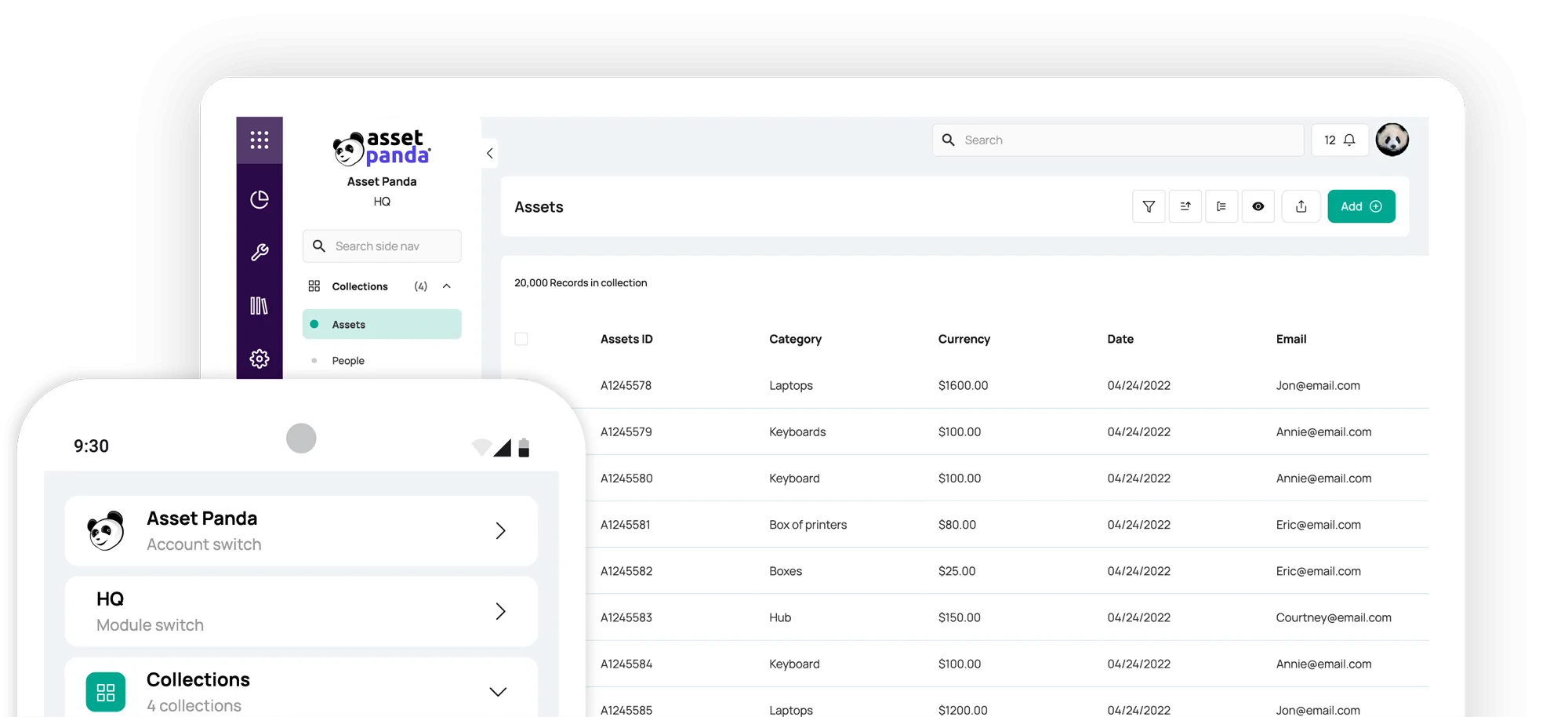
For evidence laboratories tasked with maintaining a chain of custody for evidence, a digital solution like Asset Panda can simplify the process while making it more accurate.
Asset Panda is a highly customizable system for keeping track of hundreds or thousands of an organization’s assets in a robust tagging system—complete with features to prevent mistakes or tampering to make it foolproof and secure.
How does an organization’s stewardship look when evidence is preserved through a digital chain of custody? Follow our step-by-step guide to see what changes for the better.
- Step 1: Tagging at the Scene. Use the mobile app to create a new asset record on-site, upload photos, and generate a unique barcode label.
- Step 2: Intake at the Property Room. The evidence tech scans the barcode. The system automatically logs the transfer of custody from the officer to the property room.
- Step 3: Temporary Transfer (To Lab, To Court). Use the check-in/check-out feature. Scan the item out to a detective. Capture their digital signature. The system tracks that the item is out of the property room.
- Step 4: The Return. Scan the item back in. Its status is updated, and the chain of custody is preserved.
- Step 5: Final Disposition. When a case is closed, use custom actions to document the final disposition (Returned to Owner, Destroyed, etc.) and generate a final report.
Evidence is only one of the asset categories that a digital solution like Asset Panda can be used to track, and all of these assets can be monitored and accessed through the same inclusive system. The result: a sheriff’s office that reduced asset loss by 90%, all thanks to the data accuracy and control Asset Panda provides.
From Tedious Paperwork to a Court-Ready Report in One Click
For professionals who work within the justice system, lives depend on their accuracy, integrity, and ethical standards. That’s why they can’t cut corners while preserving a chain of custody for evidence. And when it comes to efficiency, the manual process of assembling paper logs simply can’t compete with the ability to instantly generate a complete, chronological history report for any piece of evidence with the click of a button in a platform like Asset Panda.
Asset Panda is a digital solution designed for keeping track of all an organization’s short-term and long-term assets, from evidence and seized assets to equipment like laptops that professionals use to accomplish their everyday tasks. The cloud-based software can be accessed on the go (and even offline) using its mobile app. At the same time, this flexibility does not compromise its security. The highly maintained system is responsible for protecting your data from data breaches and cyber-attacks, so your organization doesn’t have to.
Imagine how the scenario from the beginning of this article would have gone differently if the detective had access to Asset Panda. When the detective was questioned about where a piece of evidence had been two years ago, they would be well-prepared to answer. Before the evidence was admitted to court, they could have used the check-out feature to temporarily take that item out of the property room, complete with the digital verification of its full location history, provided by Asset Panda’s auto-generated one-click report. It’s a simple, high-tech fix that preserves the chain of custody while restoring confidence in the system.
Your Cases Are Too Important to Trust to Paper
Ensuring evidence integrity is just one part of being an audit-ready agency. Learn how to apply these same principles of accountability across your entire department. Read The Ultimate Guide to GASB-Compliant Asset Management.
Take Control of Your Assets
A personalized demo is just one click away.
Additional resources to help you stay audit-ready


Learn more from a solution specialist
Schedule a demo to find out how you can transform your workflows with Asset Panda Pro
Contact our team at (888) 928-6112