
Asset Panda vs Airtable: Asset Tracking & Management Comparison
Compare Asset Panda
Summary
In this Asset Panda vs Airtable guide, we compare a purpose-built asset management system and a general-purpose workflow and operations platform. Asset Panda is designed specifically for tracking physical and digital assets across their lifecycle, including audits, barcode scanning, mobile field operations, depreciation, reservations, and compliance workflows. Airtable can be configured to track assets, but requires significant customization and third-party tools to approximate core asset management functionality. For organizations managing physical assets at scale, Asset Panda offers deeper native capabilities, stronger governance, and lower long-term operational risk.
| Feature | Asset Panda | Airtable |
| Core focus | Asset lifecycle | Workflow management |
| Mobile capabilities | Native audits, barcode scanning, offline mode, inspections | Limited |
| Reporting | Dashboards, grouped views, depreciation, exports | Simple views and dashboards |
| Best for | Multi-department tracking | Workflow management and automation |
By the end of this comparison guide, you can expect to learn:
- Whether Airtable's workflow-first solution covers all asset tracking needs
- Whether Asset Panda can effectively support lifecycle management and workflow automation
- How the two solutions differ in asset tracking, automations, and reporting
- Which tool scales better across departments
- How each supports the full asset lifecycle vs general workflow management
Airtable Overview
Airtable is a digital operations and workflow management platform that blends spreadsheets, databases, and automation.
What Airtable Is Best At
- Project and task tracking
- Workflow coordination
- Custom internal tools
- Lightweight operational databases
- Cross-team collaboration
How Airtable Is Used for Asset Tracking
- Simple inventory lists
- Asset assignment tracking
- Small-scale equipment registers
- Early-stage or temporary asset databases
Airtable’s Asset Management Limitation
Airtable is not purpose-built for physical asset lifecycle management. Core asset workflows—such as audits, offline mobile scanning, barcode labeling, reservations, depreciation, and compliance reporting—must be custom-built or handled through external tools.
Asset Panda Overview
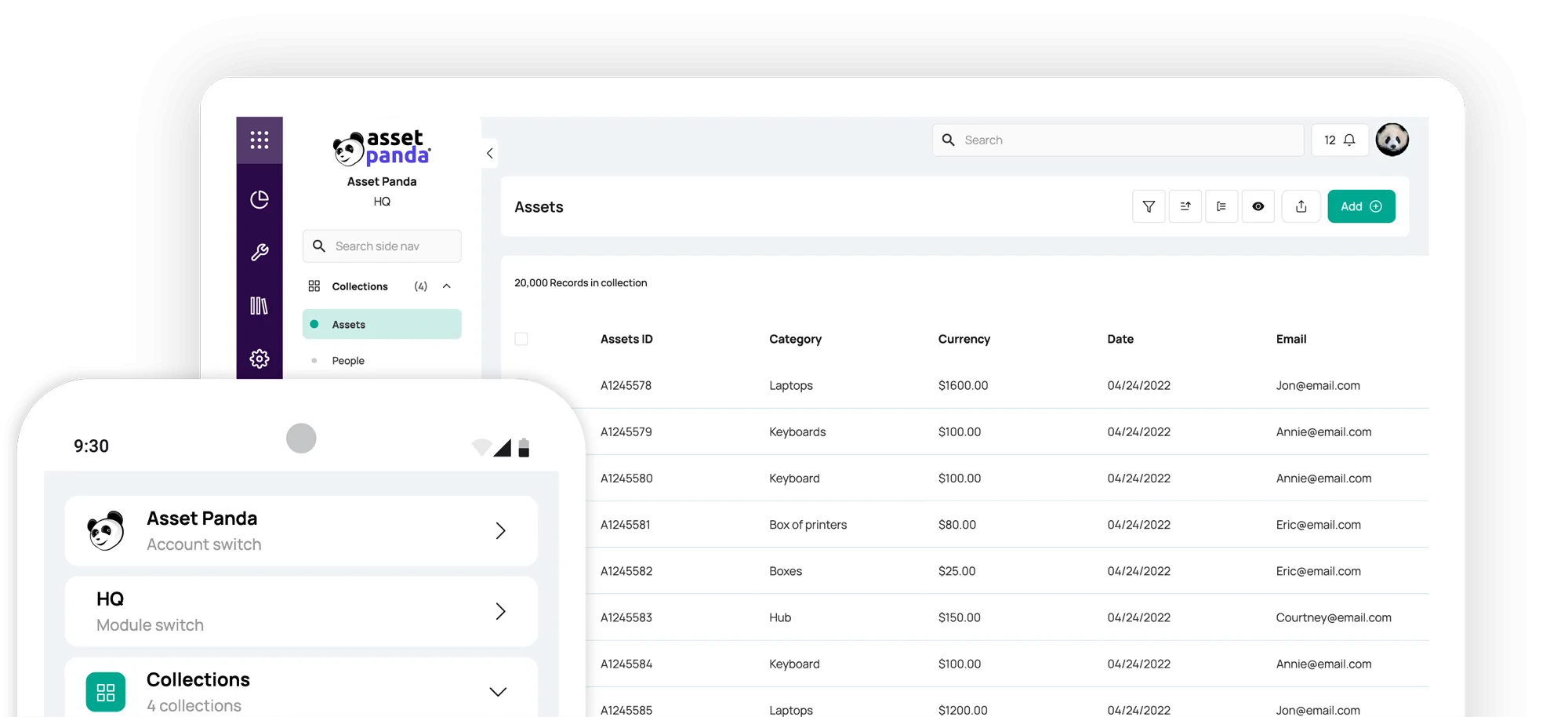
Asset Panda is a dedicated asset tracking and asset management platform designed to manage assets across their entire lifecycle. Asset Panda supports a wide array of industries and use cases with features like:
- Modular, multi-tenant architecture
- Structured asset data models with enforced schemas
- Proprietary Ursa AI assistant
- Native iOS and Android apps with offline capability
- Barcode scanning and barcode label generation
- Inventory audits and asset verification
- Check-in / check-out and reservations
- Automation for asset-driven workflows
- Dashboards, reporting, and depreciation tracking
- Enterprise-grade permissions and governance
- Integrations with IT, finance, and operations systems
- Open API for extensibility
Asset Panda is designed for asset accuracy, accountability, and scale across teams and departments.
| Feature | Asset Panda | Airtable |
| Built specifically for asset management | Yes | No |
| Physical asset lifecycle tracking | Native | Requires customization |
| Barcode scanning | Native | Not native |
| Barcode label creation & printing | Native | Not available |
| Mobile app with offline mode | Yes | Limited |
| Asset audits & inventory counts | Native | Manual |
| Check-in/check-out | Native | Custom workflows |
| Reservations & availability tracking | Native | Not native |
| Depreciation tracking | Built-in | Not supported |
| Role-based permissions | Granular | Limited |
| Compliance & audit trails | Native | Manual |
| IT & operations integrations | Native | Third-party dependent |
Deep-Dive Comparisons
Asset Customization & Data Structure
Airtable
- Highly flexible tables
- No native conditional schema enforcement
- Asset logic depends on formulas and user discipline
Asset Panda
- Enforced asset schemas using collections and categories
- Conditional fields by asset type
- Data integrity enforced across forms, imports, automations, and reports
Advantage: Asset Panda
Mobile & Field Operations
Airtable
- Mobile access available
- Limited offline functionality
- No asset-first mobile workflows
Asset Panda
- Native iOS and Android apps
- Offline audits and form submissions
- Barcode scanning, GPS capture, photos, and signatures
- Designed for technicians and field teams
Advantage: Asset Panda
Asset Lifecycle & Availability Management
Airtable
- Lifecycle must be manually modeled
- No native reservation engine
- Availability logic requires custom formulas
Asset Panda
- Full lifecycle tracking from intake to retirement
- Native check-in / check-out workflows
- Reservation-based availability
- Automated overdue handling
Advantage: Asset Panda
Workflow Automation
Airtable
- Flexible automation builder
- General-purpose triggers
- Asset-specific workflows require custom logic
Asset Panda
- Event- and schedule-based automations
- Asset-aware triggers (status, dates, categories)
- Automations connect assets to notifications and integrations
Advantage: Asset Panda
Reporting, Dashboards & Compliance
Airtable
- Views and dashboards available
- Advanced reporting often requires third-party BI tools
Asset Panda
- Saved Views power dashboards, audits, and exports
- Compliance, utilization, and depreciation dashboards
- Automated exports via SFTP
Advantage: Asset Panda
Security, Permissions & Governance
Airtable
- Workspace and base permissions
- Less granular governance
- Can become difficult to manage at scale
Asset Panda
- Organization → Account → Module isolation
- Role-based access and limited record visibility
- Field-level permissions
Advantage: Asset Panda
Use Cases Comparison
Choose Airtable If You Need:
- Lightweight asset lists
- Small-team inventory tracking
- Custom internal tools
- Short-term or experimental asset tracking
- Non-physical or abstract asset tracking
Choose Asset Panda If You Need:
- IT asset management (ITAM)
- Facilities and equipment tracking
- Government, education, or healthcare compliance
- Physical inventory audits
- Mobile and field-based asset workflows
- Scalable governance and reporting
Pros & Cons of Each Solution
Airtable
Pros
- Extremely flexible
- Easy to start
- Familiar spreadsheet-style interface
- Broad automation ecosystem
Cons
- Not designed for asset lifecycle management
- Heavy customization required for audits and compliance
- Limited native asset controls
- Governance complexity increases as usage scales
Asset Panda
Pros
- Purpose-built for asset management
- Native mobile, offline, audit, and barcode workflows
- Built-in depreciation and reservations
- Enterprise-grade governance and integrations
Cons
- Focused specifically on asset use cases
- Requires structured setup for best results
Final Recommendation
If asset tracking is mission-critical, Asset Panda is the better long-term solution. Airtable works well for flexible data management, but when organizations require accuracy, audits, compliance, and scalable governance, Asset Panda delivers native functionality that Airtable must approximate through customization.
See how Asset Panda simplifies asset tracking, audits, and lifecycle management.
Frequently asked questions
Is Airtable good for asset tracking?
Airtable can be used for basic asset tracking, but it is not designed for full asset lifecycle management. Organizations typically need significant customization to support audits, barcodes, availability tracking, and compliance workflows.
What is the difference between Asset Panda and Airtable?
Asset Panda is purpose-built for asset management, including audits, barcode scanning, reservations, depreciation, and governance. Airtable is a general-purpose database and workflow tool that requires custom configuration to manage assets.
Does Asset Panda support barcode scanning natively?
Yes. Asset Panda includes native barcode scanning on web and mobile, along with built-in barcode label generation.
Can Airtable replace an asset management system?
For small or temporary use cases, Airtable may work. For organizations managing physical assets at scale, a dedicated asset management platform like Asset Panda is typically more reliable and scalable.
Learn more from a solution specialist
Schedule a demo to find out how you can transform your workflows with Asset Panda Pro
Contact our team at (888) 928-6112