
The Risks of Using Spreadsheets as Your System of Record
Blog

Table of Contents
Take Control of Your Assets
A personalized demo is just one click away.
Somewhere in your organization, there’s a spreadsheet that everyone relies on. When someone needs the latest asset data like status, condition, or accumulated depreciation, they're not going into the ERP or another official system—they're going to that one Excel file.
At first, a spreadsheet feels like a practical workaround for your asset tracking needs. It's quick and easy for anyone on your team to modify and more flexible than complex systems. But when a spreadsheet becomes your system of record, it quietly introduces risks that are much harder to see:
- No clear audit trails
- Conflicting versions
- Inaccurate or lost data entries
For public sector organizations where compliance, transparency, and reporting accuracy are critical, this isn’t just inefficient. It’s a structural risk that grows over time.
In this article, we’ll discuss 4 risks of using spreadsheets as your system of record, and how to create a better system with a modern asset management tool.
Why Teams Default to Spreadsheets
Before diving into the risks, it’s important to understand why spreadsheets become the default. Teams often choose Excel because it’s:
- Fast and familiar
- Easy to edit and share
- Flexible across use cases
- Accessible without system constraints
Compared to rigid ERP systems or complex tools, spreadsheets often feel like the path of least resistance. And in many cases, it is—initially. But as this workaround becomes the main system of record for an agency’s assets, the risk of data inconsistencies and compliance concerns increases exponentially.
4 Key Risks of Spreadsheets for Public Sector Asset Management
When you begin using a spreadsheet as the source of truth for your asset data, it becomes your system of record. It’s no longer a document your team is referencing, but the core of your asset operations and reporting.
While spreadsheets are powerful tools, they were never designed to function as a centralized system of record—especially for complex public sector asset management.
Here’s where the risks begin to surface.
1. No Single Source of Truth
When multiple people try to manage static spreadsheets, data can quickly become lost or inconsistent. Oftentimes, people try to make updates to an Excel file at the same time and the data doesn’t sync properly, which may lead different departments to create their own file versions to avoid future collaboration issues.
The Impact: It becomes difficult to understand which asset data is most up to date, and makes for a very time-consuming reconciliation process before an audit.
2. Increased Audit and Compliance Risk
In government environments, audit readiness is critical. Since static spreadsheets don’t maintain a change history, agencies cannot easily produce audit trails—or at least not without a lot of tedious data reconciliation.
The Impact: During audits, it becomes difficult to prove:
- Data accuracy
- Asset ownership
- Financial reporting integrity
This increases the likelihood of audit delays and compliance findings.
3. Manual Reconciliation and Errors
When spreadsheets coexist with official systems, teams must constantly compare files and identify and correct discrepancies. These regular manual updates increase the likelihood of:
- Data entry errors
- Missed updates
- Incorrect reporting
The Impact: Valuable time is lost fixing data, and data may be lost or entered incorrectly due to human error.
4. Scalability Breakdown
Spreadsheets work well—until they don’t. For certain reports and projects, they’re a great and accessible tool. However, as organizations grow or have increased reporting and compliance standards to meet, spreadsheets cannot easily scale alongside them.
When asset counts grow to around 500, the scalability breakdown begins. The amount of inventory and the complexity of the data surrounding it becomes too much to handle manually, creating an even higher risk of spreadsheet errors.
The Impact: When a spreadsheet can’t keep up with growing asset tracking needs, workflows slow down and data discrepancies increase with human error or as teams start to create even more individual file versions.
How The Hidden Costs of Spreadsheets Add Up
Individually, each of the above issues may seem manageable with meticulous data entry and a few dedicated asset managers. But even with the most responsible management, spreadsheets themselves are incredibly error-prone. In fact, it’s estimated that around 94% of spreadsheets contain errors.
Many organizations assume the solution is better spreadsheet discipline, more structured processes, or additional training, but all of this misses the real issue. If your team relies on spreadsheets alongside official systems, it’s not a training problem—it’s a system design problem.
What a Better System of Record Looks Like
If spreadsheets aren’t the ideal system of record, what is?
A modern, centralized asset management platform.
With a single source of truth for your asset data, your agency will have an accurate system of record that saves your team time and boosts compliance. Things to look for in an asset management solution include:
- Immutable asset history logs for clear audit trails.
- Depreciation tracking to help you achieve financial and regulatory compliance.
- Real-time updates so you never have to second-guess your asset data.
- Multi-user access and robust permissions for seamless collaboration and security.
- Customizable fields and forms that align with compliance requirements, so you don’t need to duplicate work before an audit.
Make Asset Panda Pro Your System of Record
Spreadsheets are extremely useful tools for organizations of all sizes and industries. But when they become your system of record, they introduce risks that grow over time, including:
- Data inconsistencies
- Operational inefficiencies
- Audit and compliance risks
When your agency invests in a comprehensive asset management solution, that doesn’t mean you’re completely reinventing the wheel. It simply means you’re building a better system to support your asset workflows and data management.
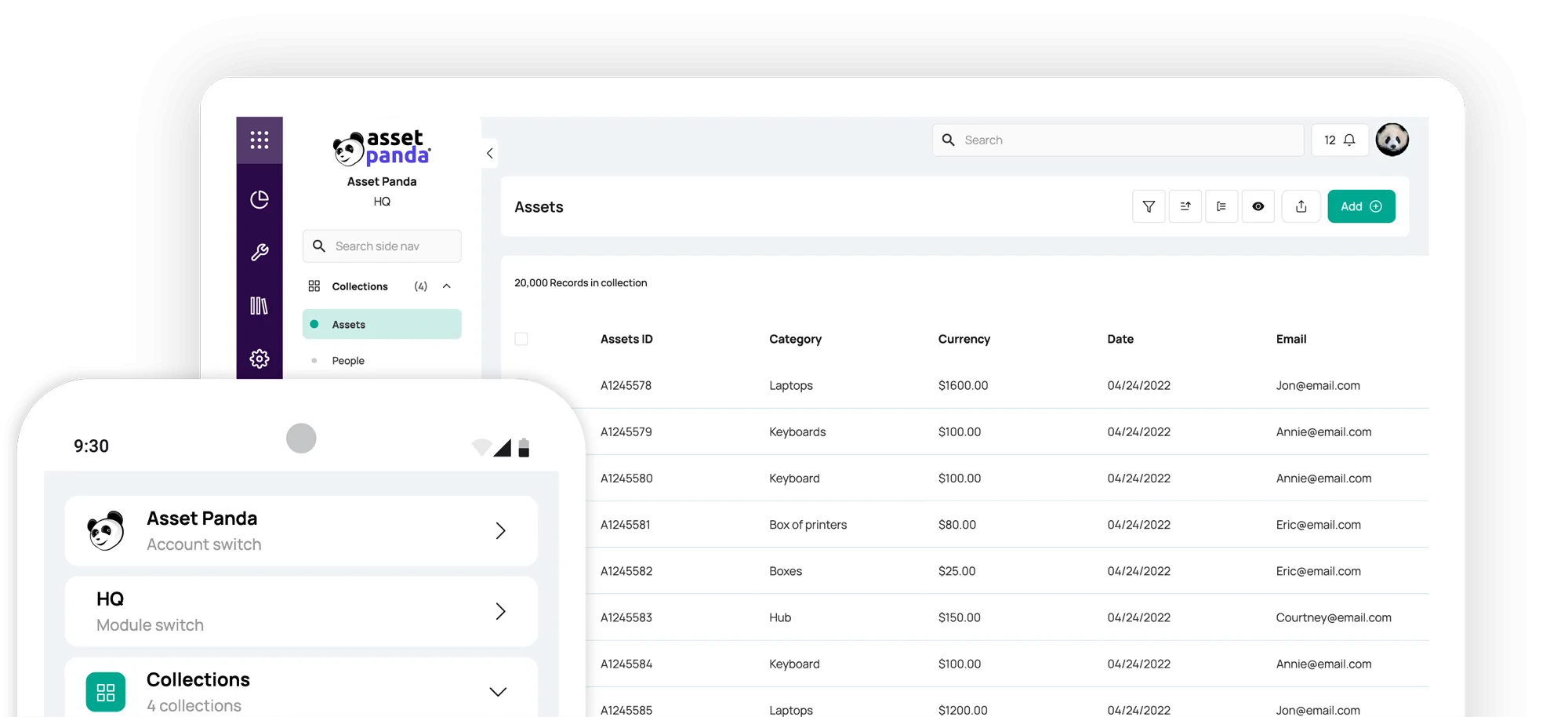
Asset Panda Pro’s centralized platform is a popular choice for state and local governments across the country. Our multi-tenant solution allows you to manage all your departments and use cases in unique accounts and collections under one secure umbrella. This means there is only one true system of record that will easily scale with you over time—no need to set up spreadsheets or ERP modules to manage additional assets and use cases.
With automatic depreciation calculations and robust integration offerings, Asset Panda Pro makes it simple to track the current value of your assets and export that data to your finance tool or ERP system. Asset Panda enables government agencies to holistically unify their asset data to save time and increase accountability.
See how using Asset Panda Pro as your system of record streamlines workflows and enhances compliance. Book your personalized demo today.
Take Control of Your Assets
A personalized demo is just one click away.
Frequently Asked Questions
Why are spreadsheets not an ideal system of record?
Spreadsheets are not designed to function as a system of record because they lack audit trails, create multiple versions of data, increase error risk, and make it difficult to maintain a single source of truth—especially in complex environments like government agencies.
Can spreadsheets be used for asset tracking?
Spreadsheets can be used for basic asset tracking, but they are not reliable as a long-term system of record. They lack automation, real-time updates, and audit trails, which makes them difficult to maintain as asset volume grows or compliance requirements increase.
What are the biggest risks of using Excel for asset management?
The biggest risks of using Excel for asset management are data inconsistencies, lack of version control, no audit trail, and manual errors. These issues can lead to inaccurate reporting, compliance gaps, and increased audit risk—especially in public sector environments.
When should an organization stop using spreadsheets for asset management?
An organization should stop using spreadsheets for asset management when it manages more than a few hundred assets, involves multiple departments, or requires audit and compliance reporting. At this stage, spreadsheets become inefficient, error-prone, and difficult to scale.
Related Resources



Learn more from a solution specialist
Schedule a demo to find out how you can transform your workflows with Asset Panda Pro
Contact our team at (888) 928-6112